






Every parent knows the struggle. You pick up your child from school, eager to hear about their day, and ask the classic question: “How was school?” The response? A predictable “Fine” or “Good,” followed by silence. Sound familiar?
The truth is, questions for kids after school can either open doors to meaningful conversations or shut them down completely. Moreover, the key lies in asking the right questions at the right time. In fact, when you move beyond generic inquiries and tap into specific, engaging prompts, you unlock your child’s willingness to share their experiences, feelings, and thoughts.
This guide provides you with creative, conversation-starting questions for kids after school that actually work. Furthermore, whether your child is in kindergarten or middle school, these strategies will help you connect deeper and understand their world better.
Why Traditional After-School Questions Don’t Work
Before diving into what questions to ask, let’s understand why the usual approach fails.
When children finish school, they’re often mentally exhausted. Specifically, they’ve spent hours following instructions, concentrating, socializing, and managing emotions. As a result, the last thing they want is an interrogation that feels like a quiz.
In addition, generic questions like “What did you do today?” require significant mental effort to answer. Consequently, your child needs to recall, organize, and articulate multiple experiences. That’s overwhelming when they’re tired.
Additionally, broad questions lack specificity. Therefore, without a clear focal point, children struggle to choose what information might interest you, leading them to default to the easiest response: “Nothing.”
The Perfect Timing for After-School Questions
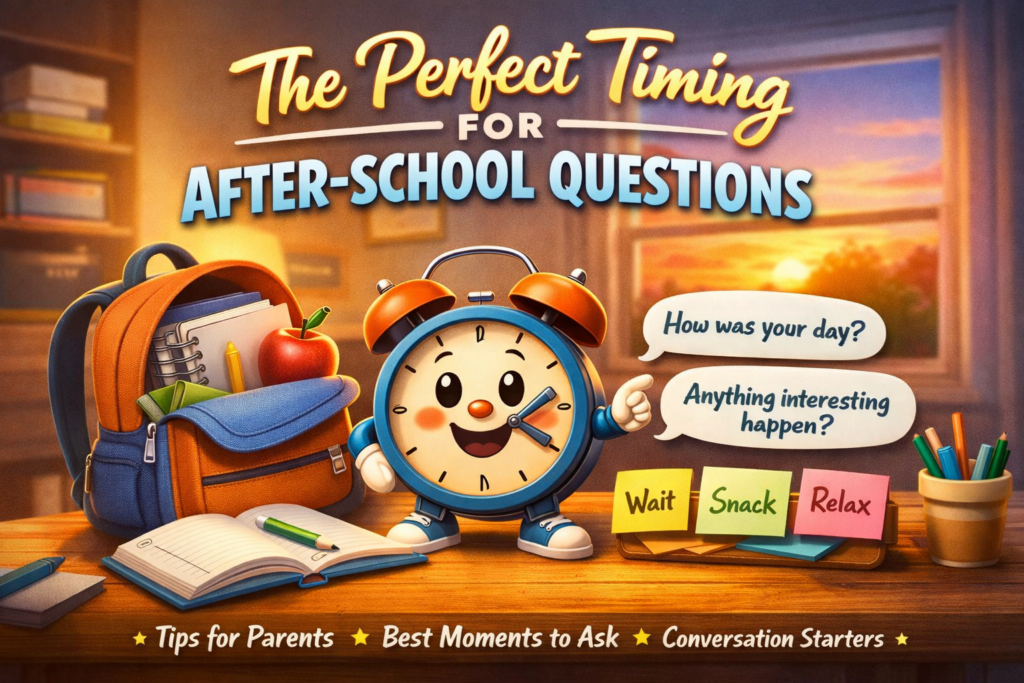
Timing significantly impacts the quality of conversations with children. However, not every moment after pickup is ideal for deep discussions.
For instance, some children need decompression time immediately after school. Instead, they might prefer a snack, some quiet time, or physical activity before they’re ready to talk. On the other hand, others open up best during car rides home when they don’t have to make eye contact.
Therefore, pay attention to your child’s natural rhythm. Meanwhile, notice when they seem most talkative and receptive. As a result, this observation helps you identify the sweet spot for asking questions for kids after school that generate genuine responses.
Furthermore, create a comfortable environment free from distractions. For example, turn off the radio during car rides, put away your phone, and give your full attention. In turn, this signals that you genuinely care about their answers.
50+ Engaging Questions for Kids After School
Here’s a comprehensive list of questions for kids after school, organized by category, to make conversations flow naturally.
Questions About Highlights and Emotions
First, consider these emotion-focused questions:
- What made you smile today?
- What was the best part of your day?
- Did anything make you laugh really hard?
- What was something kind you saw today?
- What made you feel proud today?
- Was there a moment when you felt frustrated?
- What surprised you today?
- What’s something new you learned that interested you?
Social and Friendship Questions
Next, explore their social interactions:
- Who did you sit with at lunch?
- You and your friends talk about at recess?
- Does anyone help you with something today?
- Did you help anyone with anything?
- What game did you play at recess?
- Who made you laugh today?
- Did anyone do something that bothered you?
- What’s something nice you do for someone?
Specific Activity-Based Questions
Additionally, focus on concrete activities:
- What book did your teacher read today?
- What was the most interesting thing you were doing in math?
- What do you create in art class?
- What happened during PE or gym today?
- Which project are you working on in class?
- What’s the most challenging assignment you have?
- Did you learn any new words today?
- What experiment or activity did you do in science?
Hypothetical and Creative Questions
Moreover, spark their imagination:
- If you could change one thing about today, what would it be?
- If you were the teacher tomorrow, what would you teach?
- What superpower would have been helpful today?
- If you could have lunch with anyone, who would you choose?
- What would make tomorrow even better?
- If today had a theme song, what would it be?
Reflection and Self-Awareness Questions
Similarly, encourage deeper thinking:
- What’s something you’re looking forward to tomorrow?
- What’s one thing you wish you’d done differently?
- What did you do today that was brave?
- What made you think really hard today?
- What’s something you want to get better at?
- How did you handle something difficult today?
Silly and Fun Questions
Alternatively, keep it light and playful:
- What’s the silliest thing that happened today?
- Did your teacher do anything funny?
- What’s something weird you noticed?
- If your day were a flavor, what would it taste like?
- What animal would best describe your day?
- Did anything totally random happen?
Open-Ended Comparison Questions
Furthermore, use comparison to prompt reflection:
- What was harder today than yesterday?
- What was easier today than last week?
- How was today different from Monday?
- What’s something you know now that you didn’t know this morning?
Choice-Based Questions
Finally, offer choices to simplify responses:
- What was better: morning or afternoon? Why?
- What did you like more: what you learned or who you played with?
- Would you want tomorrow to be the same as today or different?
- What part of the day went by fastest?
How to Make These Questions Work Effectively
Simply asking better questions for kids after school isn’t enough. In fact, the delivery and follow-up matter just as much as the question itself.
First of all, start with one question at a time. Specifically, don’t rapid-fire questions like you’re conducting an interview. Instead, give your child space to think and respond at their own pace.
Next, listen actively to their answers. For instance, make eye contact, nod, and show genuine interest. Then, ask follow-up questions based on what they share. As an example, if they mention playing tag, ask who was “it” or what made it fun.
Moreover, avoid judgment or immediate problem-solving. Particularly, if your child shares something challenging, resist the urge to jump in with solutions or criticism. Sometimes children just want to be heard.
Additionally, share your own day too. In other words, model the kind of sharing you hope to receive. Consequently, talk about your highlights, challenges, and funny moments. As a result, this creates reciprocity and shows that conversation is a two-way street.
Age-Appropriate Adaptations for After-School Questions
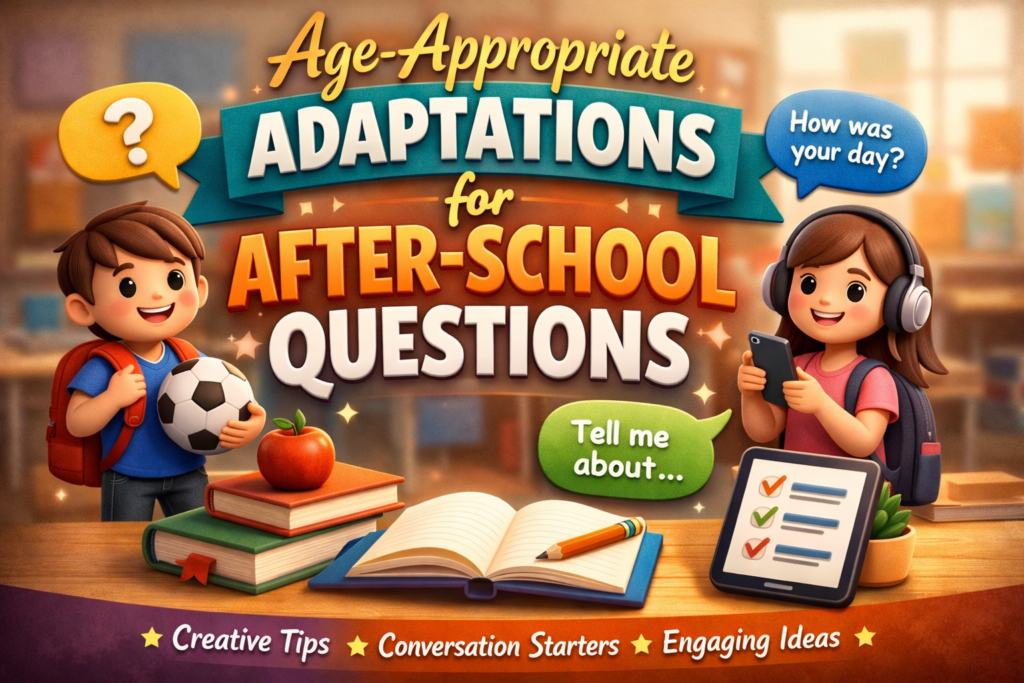
Different ages require different approaches when asking questions for kids after school.
For younger children (K-2nd grade): First, keep questions simple and concrete. Specifically, ask about specific activities, friends by name, or things they can point to or show you. In addition, use props like their backpack or artwork to prompt conversations.
For elementary students (3rd-5th grade): Meanwhile, mix concrete questions with those requiring more reflection. Furthermore, they can handle questions about feelings and preferences. Also, introduce hypothetical scenarios that engage their growing imagination.
For middle schoolers (6th-8th grade): However, respect their need for independence while staying connected. Therefore, ask open-ended questions that show trust in their judgment. Nevertheless, avoid questions that feel invasive. Ultimately, give them control over what they share.
Teenagers may resist direct questions entirely. Instead, try parallel conversations during activities like cooking, driving, or walking. In fact, sometimes side-by-side conversations feel less intense than face-to-face ones.
Building a Consistent After-School Routine
Consistency helps children anticipate and prepare for conversations. In particular, when questions for kids after school become part of a predictable routine, children relax into the process.
For example, consider establishing a daily “highlight and lowlight” practice during snack time. Specifically, each family member shares one good thing and one challenging thing from their day.
Alternatively, create a question jar filled with various conversation starters. Then, let your child pick one question each day. As a result, this gives them agency and makes the process feel like a game rather than an obligation.
Similarly, some families use car rides home as their designated talking time. Meanwhile, others prefer the dinner table. Ultimately, find what works naturally for your family’s schedule and stick with it.
For More: https://tordare.com/questions-for-kids-about-dad/
Conclusion
Mastering the art of questions for kids after school transforms those awkward car rides and quiet afternoons into meaningful connection opportunities. In fact, the questions you ask signal to your children that you genuinely care about their experiences, feelings, and thoughts.
Therefore, start small. Specifically, choose three to five questions from this list that resonate with your child’s age and personality. Then, test them out this week and pay attention to which ones generate the best responses. Afterward, adjust your approach based on what works.